Security rules
Who may read and write what, evaluated on every request.
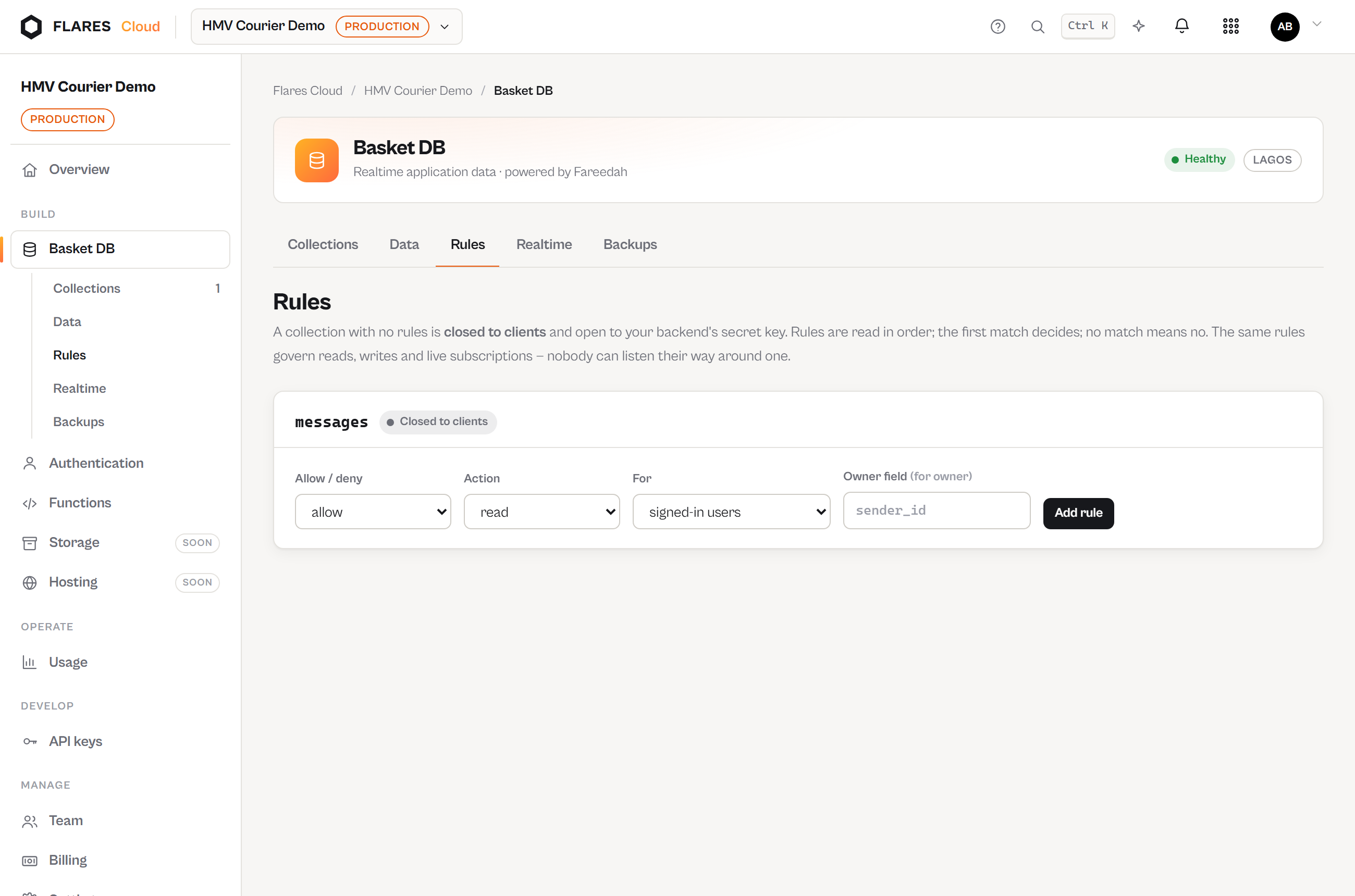
What a rule is
A rule answers one question: may this caller perform this operation on this record?
Rules are attached per collection per operation (read, create,
update, delete) and are evaluated on every request —
console, SDK, curl, realtime subscription alike.
The conditions
| Condition | Allows when |
|---|---|
public | Anyone with a valid project key. |
authenticated | The request carries a valid Flares Auth access token. |
owner | The record's owner field equals the authenticated user's id. |
server | The caller holds a secret key — backends only. |
never | Nobody. Useful for append-only collections (create allowed, update never). |
Identity in rules
When a request carries an Auth access token, the rule sees:
auth.user.id        the Auth user's id (usr_…)
auth.user.email     their email
auth.user.claims    the claims on the token
So sender_id == auth.user.id means "a user may only create messages as themselves" — enforced by Basket, not by your frontend's good manners.
A worked example
messages.read     authenticated
messages.create   owner   (owner field: sender_id)
messages.update   never
messages.delete   server
Signed-in users read the collection and write only their own messages; nothing edits history; only a backend deletes. How tokens reach the rule →
A collection with no rule for an operation refuses that operation. The default is closed —
forgetting a rule cannot open your data.